Rooted cosmopolitanism vs. Insular indigeneity

Dr Amir Ali, Assistant Professor, Centre for Political Studies

Dear Sudhir. I read your blog post on political theory. First of all, it is great that you made the effort to write in a field that is so jealously guarded by political theorists who have basically made political theory into a priestcraft. In this priestcraft of political theory there is a panoply and pantheon of conceptual gods – liberty, equality, democracy, civil society, and so on.

I completely agree with you on the need for political theory to be emancipatory. I do not know what you mean specifically by emancipation and I hope that in your next post you explain and expand upon this a little more. But let me set out what I mean by emancipation in political theory. To my mind, it is intimately and inextricably linked to the human condition a large part of which is the self-imposed bondage of human beings. Political theory must reflect upon this self-imposed bondage and seek to remove it. I think every society creates its own form of self-imposed bondage and political theory needs to pick the locks of these chains. This idea of course comes very much from Rousseau. 

Let me also add that I think that political theory over the centuries has kept coming back to the same set of questions. There is thus something enduring about political theory. This endurance is not of the form of the questions remaining exactly the same, but their constancy emerges from the flux and change of society itself. To reiterate what this means is that political theory’s constantly unchanging questions are a function of the ever-changing nature of societies.

Where I disagree with you is the idea of distancing from European and first-world contexts. For better or worse Europe and the first world colonised our part of the world and other parts such as Latin America and Africa. I completely reject post-colonial ideas and am largely uncomfortable with decoloniality for its exaggerated and affected distantiation from Europe and the first-world. I have as much interest in Europe as I have in India, Africa, and Latin America. I reject the insularity of indigineity in favour of a rooted cosmopolitanism. And here I stress rooted cosmopolitanism because it is premised upon my identity as third-world scholar, yet one who engages actively and enthusiastically with other parts of the world. 

My political theory is thus one of a rooted cosmopolitanism and not one of an insular indigineity.

Political Theory of the “Backwards”: Part I

In India, the term “backward” has a specific meaning. It refers to a group that is considered traditionally marginalized. Though in the social hierarchy, as defined by the Hindu Verna system, this group considers itself one step ahead on the caste ladder, in reality, all such groups are part of what is referred to as Shudras. I don’t want to get into the debate about who are Shudras. Jyotirao Phule and Dr. B R Ambedkar in their various writings have explained it quite eloquently. My concern here is, to initiate a new debate about the idea of a political theory and what it has to offer to those called the “backward.” When I hear discussions about political theory, it’s all full of scholars who come from a certain caste, class, or cultural background. They talk in a language that is quite professional and specialized and specifically meant for theory formation. A major concern of this branch of scholarship is to think in terms of ontology, epistemology, and above all harbingering upon the knowledge traditions which were developed in an alien space popularly referred to as “the west.” Another form of knowledge that these scholars refer to is the traditions that are referred to as indigenous and concern themselves with a particular form of traditional knowledge. The knowledge hierarchy that is produced in the name of theory is built upon these two foundations.

In both cases, the idea of political theory seems hollow as its conceptual categories, methodologies, and above all its sociological character barely reflect the reality of Indian society, the prevailing power relations in it, and above all its thinking processes and complications. There are only a few names that are used as only symbolic figures in the name of representation who refer to the very idea of political theory in India as a Brahmanical project. Even their ideas are preferred because they don’t really challenge the philosophical foundations of the political theory that scholars in India “do” in a methodological sense. The challenge to the Brahmanical project also operates within the Brahmanical folds of political theorizing.

The attempts to bring in concerns for Dalits (popularly referring to the untouchable communities also referred to as the Scheduled Castes, but in real sense Dalits also refer to the Schedules Castes, Tribes, and the Backward Castes) were emphatically highlighted by Dr. Ambedkar through his various writings. Since the backward castes considered themselves above the untouchables, they considered themselves as a separate social group that could identify themselves more closely with the upper castes. Some backward castes being the land-owning castes also added to this phenomenon. This resulted in a situation in the Indian knowledge industry wherein the “backward” didn’t think of carving out any space for their knowledge as they identified Brahmanical or Colonial forms of progress as emancipatory forms meant for them as well. Consequently, the backward castes can be seen in India trying to imitate caste-based mobilization and socialization quite in line with the similar efforts by the Brahmins, Rajputs, or the Banias. This process of mobilization or caste-based networking may not be a homogenized, unilinear process but psychologically, ethically and in terms of ideas, identification with the upper castes is a motivating force for the backward castes in larger parts of India.

The project of political theory nicely feeds into this narrative by lack of providing any exposure to conceptual categories which emerge or relate to the experience of any of the backward communities. The same can also be said about the experiential realities of Dalits and women. A political science classroom in Indian universities doesn’t problematize the prevailing knowledge hierarchies in any fundamental sense. The prevailing realities of caste-based socio-political or economic hierarchies that form the basis of various forms of social order in India despite it getting weakened in the wake of globalization do not figure in the political science syllabi. The experiential realities of working communities are not concerns of Indian political theory teaching and learning. In the name of Indian knowledge traditions or Indian intellectual traditions, the localized forms of knowledge that formed the core of the Indian rural and agrarian societies are being further marginalized.

The contemporary political theory, its philosophical concerns, and its conceptual foundations, in India, is a “backward theory of those who are historically forward”, whereas what it needs is a theory of the “forward defined in terms of a dream of a better life for those who are backward”. Such a theoretical intervention demands out-of-box thinking of conceptual categories as well as methodological endevors. A political theory that doesn’t open up avenues for democratization needs to be critically questioned on multiple fronts and if need be should be discarded. We need to remember that the political theory that is being taught in the western university system even to date doesn’t deal with what is called the “natives” and their concerns. The only manner in which such concerns figure is through the theories of exclusions. Exclusions are not a powerful conceptual category used in political theory.

To me, a political theory ought to be emancipatory in nature. Here, I don’t mean emancipation in terms of attaining liberation or Moksha as the great Indian traditions do. Emancipation is the rights of individuals being protected so that anyone can harness his/her creative potential self for the imagination of a life that is full of happiness, satisfaction, and meaning. Such emancipation is about material goods as well as emotions- emotions of joy, peace, and above all recognition with dignity. All of these conditions emanate from one’s work other than the measurement of material resources defined in terms of purchasing power capacity. Does the current political theory in India offer that?

My simple answer is “No”. I have already highlighted some of the features above on the basis of which I argue this. In the traditional Indian intellectual traditions, the whole culture of work and work culture gets subsumed in the overarching category of Shudras. One common feature of Shudras is that they are the workers (kaamgaars). Pottery, farming, carpentry, handicraft making, cooking, serving, and the list can go on. They are workers who struggle in the field with various tools and inputs. They are the ones who possess the skill, and knowledge that makes the life around us colorful, diverse, and beautiful. They also struggle to ensure that production happens so that the supply chains are not disrupted. They are the ones who make sure that the life of others also keeps functioning smoothly. They perform all of these functions while possessing their knowledge of all of these skills with them. They are the ones responsible for developing seeds that could survive during drought conditions. They are also responsible for developing techniques for saving water or animal rearing or designing village architecture so that it could cater to the requirements of various sections of society.

Yet, the absence of an agency to convert these activities and skills into the form of knowledge, boils down to being a skill and not an art of knowledge. It gets converted into knowledge when the powerful sections of society recognize them as knowledge. However, by the time it happens, it’s a bit late for the ‘backward’ themselves. By that time, art has already been converted into a commodity of knowledge production. The contemporary knowledge industry is undergoing this form of transformation only.

For such workers, the first condition of emancipation is recognition of their work i.e. some form of acknowledgment. The jajmani system provided that much space and it was enough for the backward to feel dignified. The caste system in India along with masculinity, patriarchy, and exclusion has survived with this bare minimum sense of recognition. For the backward, any small-one form of recognition from the dominant section is enough of an achievement. Even to date, the majority of backward communities are trying hard to achieve the status of a social category that is recognized either by the Brahmins or by the Rajputs. Backward communities in India, irrespective of their status of wealth still draw a sense of pride from false recognition in the Indian social order. There is no pride for them in the traditional works that they or their forefather did.

The Marxist notion of class or economy of class emanating from the economic agenda of emancipation such as equal pay for equal work comes after this social fight for recognition. Acknowledgment of human dignity is the first step to beginning a discussion on emancipation. The current political theory in India refers to empty, hollow conceptual categories which emanate largely from a tradition that too of a certain king. It has more to do with the spiritual, and religious aspects of human beings. Spirituality and religion give meaning to human life but only after their labor is recognized.

The current political theory is all about ideas and thoughts emanating from specific types of texts and their interpretations. What they lack is a description of the workers’ everydayness of struggle, hardships, joy, pleasure, community, alienation, or emotions. Here the worker is not a Marxist notion. It refers to any form of labor: physical, mental, or emotional that is being put in to get a reward along with due recognition and dignity. It also demands the right of such individuals and groups to express their concerns independently on various platforms. It rests upon the whole idea of representation.

However, the present-day political theory discourse in India is away from such empirical concerns. It leaves such empirical concerns to be studied by other “junior disciplines.” Political Science is presumed to be a master science that should engage only with the question of thought, its interpretation, and reinterpretation. Within this, the political theory doesn’t deny the existence of such discourses and yet it doesn’t engage with such efforts. Instead, it tries to appropriate all these forms of knowledge in the category of Indian intellectual and knowledge traditions. In reality, they are the knowledge of soil belonging to the real workers and no intellectual can claim them to be their own.

So when I say the “political theory of backward”, it refers to the aspects. of work, labor, its hardships, and associated forms of humiliation, exclusions, and marginalization. it wouldn’t originate from texts but from the experiential articulation of their work. It would also acknowledge the kind of ideas propagated by the texts of tradition but they won’t be the only defining feature. The methodology of this theory has to be empirical and yet it won’t be devoid of a dream of coming up with wider generalizations about other forms of knowledge.

It’s the poverty of political philosophy in India that doesn’t acknowledge the poor beyond welfarist measures. It doesn’t talk about the cultural formulations of the workers and their life experiences. it rather focuses on empty conceptual explorations. For example, it talks about secularism, and religion without referring to the empirical realities of riots, and religious violence. it talks about exclusion, discrimination, and non-representation without linking it with caste atrocities. It presumes that the former is the concern of theory whereas the latter is the concern of policy or government or may be the subject of empirical analysis. The deliberate creation of this false dichotomy of empirical versus conceptual serves the purpose of those who would want to defend traditions under the garb of knowledge while fitting it within the popular conceptual frames emanating from the “European” continental philosophy. In other words, the poverty of the philosophy of Indian scholars is a colonial hangover without accepting the same.

Before concluding let me also stretch this argument a bit further. Precisely, this is the reason that women are still out of the purview of political theory in India. Women are workers in the household, on the farms, and also in the community. However, their role is defined by the same traditions that define the work ethics of Shudras. Hence, the only articulation of their concerns in political theory is through feminist inquiry. Political theory in India minus feminism indicates a complete absence of recognition of women as a group.

I would like to discuss a few more aspects of political theory in India in the next few episodes. Keep reading and keep commenting

‘सामाजिक समरसता’ से ‘सामाजिक दुरी’ का सफ़र

कुछ वर्षों पहले तक भारत में अक़सर सामाजिक समरसता की बात होती थी।  हम एक मिला जुला और विविधताओं वाला समाज हैं।  यही हमारी कमजोरी भी समझी जाती रही है क्योंकि राजनीतिक विज्ञानी बताते हैं की लोकतंत्र और फ़ेडरल व्यवस्थाएं वहां आसानी से स्थापित हो पाती हैं जहाँ समाज एकसार हो।  भाषा , वेषभूषा और अन्य विविधताएं एक मजबूत राज्य व्यवस्था के निर्माण में समस्याएं पैदा करती हैं।  इन्ही विविधताओं को दुरुस्त रखने और लोकतान्त्रिक व्यवस्था को बनाये रखने के हमारे वादे ने हमें सिखाया की विविधताएं स्वाभाविक हैं और मनुष्य का मनुष्य के साथ सम्बन्ध मानवता का है, बाकी सब उसके बाद आता है।  हम ये कितना समझ पाए या नहीं वो अलग मुद्दा है परन्तु सैद्धांतिक तौर पर भारतीय समाज में इसको लेकर एक कटिबद्धता रही है।

हम हाथ मिलाने से लेकर, गले मिलने तक की परम्पराओं को धीरे धीरे और गूढ़ता से अपना रहे थे। अपने कॉलेज के दिनों में हम सब एक दूसरे से गले मिलकर ख़ुशी का इजहार करते थे।  इसमें न तो लिंग का भेदभाव था और न ही पसीने की दुर्गन्ध का सवाल। ऐसा लगता था ये तो स्वाभाविक ही है।  दिल्ली पहुँचने पर वो कम हो गया परन्तु हाथ मिलाने की परम्परा चलती रही।

इससे पहले की हम अपनी समाज व्यवस्था को पूर्णतः मानवता के इन सिद्धांतों से जोड़ पाते, नॉवल कोरोनावायरस ने इस पुरे मुद्दे को सर के बल खड़ा कर दिया है।  आज लगातार सामाजिक दुरी के प्रवचन ने जैसे हमारे दिलों में हमारे साथियों के लिए एक डर  सा बैठा दिया है।  हम घरों में बंद बैठें हैं लेकिन सोच रहे हैं किसी के हाथ में कोरोना तो नहीं , कहीं हवा में उड़कर तो नहीं आ जायेगा।  हर सामान को घूर कर देखना की कहीं कोरोना तो नहीं है , जैसे की हम उसे नंगी आँखों से देख सकते हों।

हर साथी अब एक चलता फिरता कोरोना ही नज़र आता है, साथी नहीं।  शायद दो तीन महीने के इस लॉक डाउन अनुभव में हम ये भूल ही जायेंगे की समाज में गर्मजोशी से मिलना क्या होता है।

ऐसे में ऑनलाइन टीचिंग-लर्निंग (या इसका उल्टा) का भूत ओर सर पर बैठा है। अपने विद्यार्थियों ये बात चित का माध्यम फ़ोन है या ज़ूम अंकल, या स्काइप अंकल या गूगल आंटी।  अब उन सब के चेहरे लगता है किसी दूर देश में हैं और मैं अपने कमरे से आवाज़ लगा रहा हूँ। आमने सामने बैठकर एक दूसरे की आँखों में आँखें डालकर किसी मुद्दे पर अपने तर्क को मजबूती से कहने के लिए जो मेहनत हमने की वो अब बेमानी लगती है।

थोड़े दिनों में तो अगर वीडियो कॉल में भी मास्क पहनकर बैठने लगें तो कोई हैरानी नहीं।  मास्क पहनकर सेल्फी लेते हुए लोगों को देखकर मुझे लगता है की ये घूँघट पहनकर फोटो खिंचवाने वाली महिलाओं से कम अनुभव नहीं है।  पर हम तब भी खुश थे और आज भी खुश हैं।

वैसे भी धीरे धीरे मोबाइल फ़ोन, एप्प्स , टेलीविज़न इन सबने सामाजिक दुरी को पहले ही मजबूत तो कर ही दिया था।  समाज केवल एक वर्चुअल दुनिया ही रह गयी थी, बाकी तो तकनीक ही थी। इस वर्चुअल दुनिया में मुद्दों को सुलझाने के प्रयास करने की कोई आवश्यकता नहीं – बस ब्लॉक कर दीजिये।  मामला खत्म। और तो और दूर की मध्यस्थता की भी आवश्यकता नहीं। व्यक्तिवाद को इससे अधिक मजबूती क्या मिलेगी?

पर इस सब के बीच अकेलेपन का क्या ? बहुत सारे लोग ऐसे होंगे जिनके पास तो बातचीत के लिए कोई नहीं होगा।  हंसने झगड़ने के लिए कोई नहीं होगा , क्या उनका काम केवल वर्चुअल दुनिया से चल जायेगा?

और वो जिनके पास इस दुनिया का हिस्सा बनने के लिए नागरिकता के प्राथनिक संसाधन जैसे स्मार्ट फ़ोन, इंटरनेट कनेक्शन या रिचार्ज के लिए पैसा या कैमरा और माइक और सबसे बड़ी बात एक शांत बंद चैम्बर नहीं होगा डिजिटल कम्युनिकेशन के लिए , क्या वो प्रवासी मजदूरों की तरह होंगे? नयी सदी के नए प्रवासी मजदुर !

पर शायद जब तक सब कुछ नार्मल होगा तब तक नया नार्मल पुराने नार्मल को समाप्त कर चूका होगा।  सामाजिक समरसता की अवधारणा पर कोरोना की जीत हो चुकी होगी क्योंकि फिर हम नंबर होंगे , इंसानी नाम नहीं। हमारे शरीर का डिवाइस नंबर होगा , सुगंध दुर्गन्ध, पसीना नहीं।  हम डिजिटाइज्ड हो चुके होंगे, हमारे जीवन मूल्य ‘टर्म्स एंड कंडीशंस’  में बदल चुके होंगे और रिश्ते – वो तो एप्प में तब्दील हो चुके होंगे।  नयी सदी में स्वागत है मेरे ग्रुप मेंबर्स।

सुधीर

सामाजिक दूरी

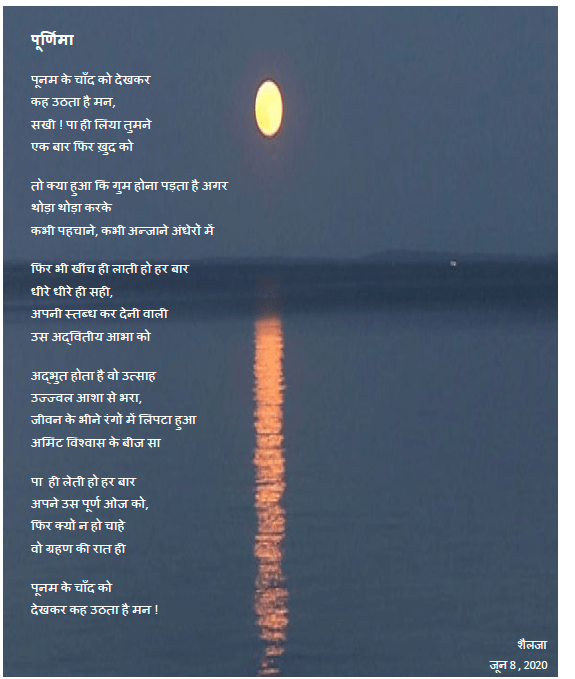
कुछ यूं आयी उभ तस्वीर

सामाजिक दूरी की,

सामाजिक दूरी बनाए रखने के ऐलान पर

इक सिरे पर थी

घर से निकल पाने की ख्वाहिश,

तो दूसरे पर थी

घर तक पहुंच पाने की गुजारिश

इक ओर थी कवायद

माह भर का सामानगुज़र जुटाने की,

तो दूसरी तरफ थीं कतारें

रोज़ी के मारों के लिए बंटते खाने की

ये कतारें भी थी उनके कारण

जो कुछ नेकदिल थे मदद के क़ाबिल,

कहाँ दूरी के दूसरे छोर को

इंसानियत का ये मौका भी हासिल

कुछ लोगों के ज़ेहन में

आतेजाते रहे फ़ुरसत के ख़्याल,

दूसरे छोर पर तो बस सताते रहे

रोज़गार के मसाएल

मुश्किलों के दौर तो

आते और जाते हैं,

सामाजिक दूरी बनाए रखने का दौर भी चला ही जायेगा

काश की ये दौर कुछ इस तरह जाता

की समाज के उस छोर की दूरी को मिटा पाता

-शैलजा

गुरिल्ला ढाबा, जनरल डायर, और ‘नो प्रॉफिट – नो लॉस’

लोगों को लगता है की जेएनयू के विद्यार्थियों को अनुशासित करने की आवश्यकता है। पर क्यों ? उनके रोज़मर्रा के जीवन में एक आज़ादी है ।पर साथ ही एक स्व अनुशासन की ललक भी। ये उसी को महसूस हो सकता है जो इसका हिस्सा रहा हो या जिसने इसको करीब से देखा हो। इस पूरी दिनचर्या में न तो लेफ्ट विंग आता है और न ही राइट। ये पूरा क्रम विचारधाराओं के संघर्ष से परे है।  जेएनयू के विद्यार्थी इन सब गतिविधियों में इतने खोजी प्रवर्ति के हैं की लगता है की ये तो कोई नयी पीढ़ी ही है जो इतना सब कुछ कर सकती है। या फिर एक पुरानी पीढ़ी फिर से जीवित होती लग रही है। वही अपने समाज, अपने विचार, अपने जगह से एक लगाव और उसे बचाने की एक ललक। आज़ादी के संघर्ष  का मंज़र भी तो कुछ ऐसा ही था।

gurilla dhaba photo1

मिसाल के तौर पर विद्यार्थियों की एक नयी खोज है ‘गुरिल्ला ढाबा’। पूरी तरह विद्यार्थियों द्वारा संचालित। जैसा की पहले तो नाम से ही समझ आता है की ये किसी किस्म का ढाबा है, मगर गुरिल्ला ! अक्सर गुरिल्ला को गुरिल्ला युद्ध से जोड़कर देखा जाता है। तो फिर ये ढाबा कहाँ से आया ?

Continue reading

A governance crisis, and not revolution, is in making

Justice Markandeya Katju in one of his recent write-up indicated how the prevailing economic, social and political conditions in India resemble situations prevailing in the pre-revolution France. Hence, according to Katju a revolution is in making in India.

Certainly, there is a prevailing sense of anxiety and a sense of uncertainty about the political and economic developments in contemporary India haunting every sensible citizen. The economic conditions are worsening. Job market is collapsing. The institutional ethos and governance practices are crumbling on everyday basis. Above all people’s trust in various institutions to address their concerns is eroding.

Governability Crisis

I believe that there is a new political scenario in making. Indian political conditions are moving more in the direction of a governability crisis characterised by poor law and order situation, or anarchy in place of any form of a large-scale structural change, as predicted by Justice Katju. Two explanations can be given to explain this new political conditioning.

First are the worsening social conditions that can be seen as indicators of gradual destruction of existing social order. And second is the emerging political chaos that is destroying the constitutional-institutional order, along with an absence of alternative political ideas and organized political opposition.

The prevailing conditions are not only of the poor economy but also of the social crisis that is in making. The rising crime rates can be seen as indicative of this trend. The data available with the National Crime Records Bureau shows a rising trends in certain kind of crime rates.

For example, the number of violent crime reported in the year 2014 at all India level was 33,0754. It witnessed a jump of 30 % in a time span of three years. 42,6825 were reported in the year 2017 at the all India level.

Similarly, there is around 20 % rise in the total no of cases registered of kidnapping and abduction. In the year 2014, 77237 cases registered under this category. It has gone upto 95,893 cases by 2017. Crime against women, senior citizen, children and cyber crimes have witnessed a sudden rise in the last five years.

The crime against women recorded in 2014 were 33,7922 but went upto 35,9849 by 2017. The crimes against children recorded in 2014 were 89,423. This witnessed almost 30 % rise and went upto 129032 cases in 2017. Crimes against Senior citizens have also seen a rise with 20532 cases in 2015 to 22727 in 2017.

The biggest rise has been in the category of cyber crimes. In the year 2013 total number of cyber crimes recorded were 5693. This went almost five times higher and reached upto 21796 in 2017.

This data reveals that not only the crime rates are rising but also the nature of crime is undergoing a change. The emerging harsh economic conditions, lack of employment opportunities and above all gradual communalization and polarization of public spaces and inter-community relations can be seen as a root cause of increasing rates of crime.

Unlike the earlier trends when mega cities were the epicenter of the crime, now it is the small towns or emerging cities (like Hyderabad, Jodhpur, Lucknow etc) those are the epicenter of new crimes.

Mega cities are less likely to be affected from such scenario due to the strong presence of the state, technology and above all the market players. The focus of state policy is also on maintaining status quo in the mega cities as it also ensures safety and security of the state apparatus. The emerging crime scenario outside the mega cities or in the peripheries is resulting into a new governability crisis.

These kinds of conditions are likely to produce a social order that is of fear, terror, and insecurities. The political institutions those are expected to play the role of impartial actors with fair procedures in such times have already been delegitimized by the ruling dispensation.

The constitution makers or the leaders of the freedom struggle envisaged the federal structure for the preservation and promotion of not only of cultural diversities but also of political as well as economic diversities in various parts of India. This idea of federalism is under a serious threat due to the new governance framework of over centralization and homogenization.

There are efforts by the ruling party to destroy any form of opposition to its socio-political-cultural ideology.

Above all the constitutional normative structure consisting of values of equality, justice, tolerance, and democracy is being replaced with an accepted sense of inequality, hierarchies, a sense of caste and religious superiority, illiberalism and whataboutry. The ruling leaders of our time are celebrating inequalities in the name of prosperity. Policies like National Register for Citizens are the best examples of state policy of promoting mistrust. A cumulative impact of this is the emergence of a sense of political confusion in various political groups.

The rising levels of mistrust and emotional vacuum have gradually penetrated into public psychology. Rising cases of mob lynching and heinous crimes are a manifestation of such conditions. TV channels through their newsroom propaganda have further contributed to this kind of destruction. Under such situations people would see ‘others’ as a ‘threat to their existence.’

With the decline of institutions, lack of political alternative and state’s unwillingness to recognize that there is a public anguish, the present conditions are more likely to lead to what is referred in the classical Indian writings as arakjkta or what is referred in European context as a ‘Hobbesian state of anarchy.’

Zero probability of large-scale change

If one considers major structural changes as an outcome inferring from the prevailing socio-political conditions, there can be two probable scenarios. Firstly, a revolution, like France, as Justice Katju attempts to argue, can be the outcome. Secondly, there can be color revolutions like the Middle East or Eastern Europe.

In my opinion looking at the present Indian conditions any major structural change is least likely to happen. There are two major factors that would prevent any such change. First is the presence of a very strong foundation of electoral democracy. People have deep faith in the Indian electoral system irrespective of all its ills, and it seems that this would continue to be so. In one of the survey conducted by the students of Centre for Political Studies, a majority of respondents said that they believe that it’s their civic duty to participate in the elections and cast their vote. No political actor in India is in a position to disregard this strong political feeling.

Second factor that would minimize possibility of any radical change is the presence of the domestic as well as global market actors who have heavy stakes in the stability of the political as well as economic regime. These stakes are extremely high in the current regime given its policies favoring corporates even at the cost of people’s well being. The emerging global economic conditions also make it difficult for the market actors to risk anything at the cost of Indian market.

In any kind of examples of structural change be it the French case or Russian or East European cases, both these conditions (an electoral democracy and global market players) were absent at the advent of the revolution. Though the market players did exist but not as organized and globally connected as they are today, thanks to the technological innovations. The color revolutions, on the other hand, were aimed at demanding an electoral, liberal democracy. Such a political system exists in India despite a large number of problems in the electoral democracy. Besides, the history of communist rule or presence of an authoritarian leader played a major role in emergence of ‘revolutions’ in these countries. The prevailing Indian conditions as well as the historical conditions are qualitatively distinct. Hence, even this kind of scenario is less likely to occur.

Contemporary Farmers’ Protests and the ‘New Rural-Agrarian’ in India

What are the reasons behind farmers’ protests? Using narratives collected from various parts of India, the underlying processes of socio-economic transformations, which have created a dual-identity crisis among farmers, are explained to argue that anxieties have manifested in large-scale protests, producing a new politics around rural–agrarian questions.

The full paper was published in the Economic and Political Weekly in Vol 53, No 26-27. 30 June 2018. Follow the link to read the article

मोदी सरकार को समझना चाहिए कि उच्च शिक्षा संस्थान जनसंपर्क कार्यालय नहीं होते

सीसीएस जैसे क़ानूनों का उद्देश्य उच्च शिक्षा के उद्देश्यों को ही ध्वस्त कर देना है. उच्च शिक्षा में विकास तब तक संभव नहीं है जब तक विचारों के आदान-प्रदान की आज़ादी नहीं हो. अगर इन संस्थाओं की ये भूमिका ही समाप्त हो जाए तो उच्च शिक्षा की आवश्यकता ही क्या रहेगी? शिक्षक और शोधार्थी सरकारी कर्मचारी की तरह व्यवहार नहीं कर सकते.

पूरा लेख जो की वायर हिंदी में 4 नवंबर 2018  को छपा था को  पढ़ने के लिए यहाँ क्लिक करें